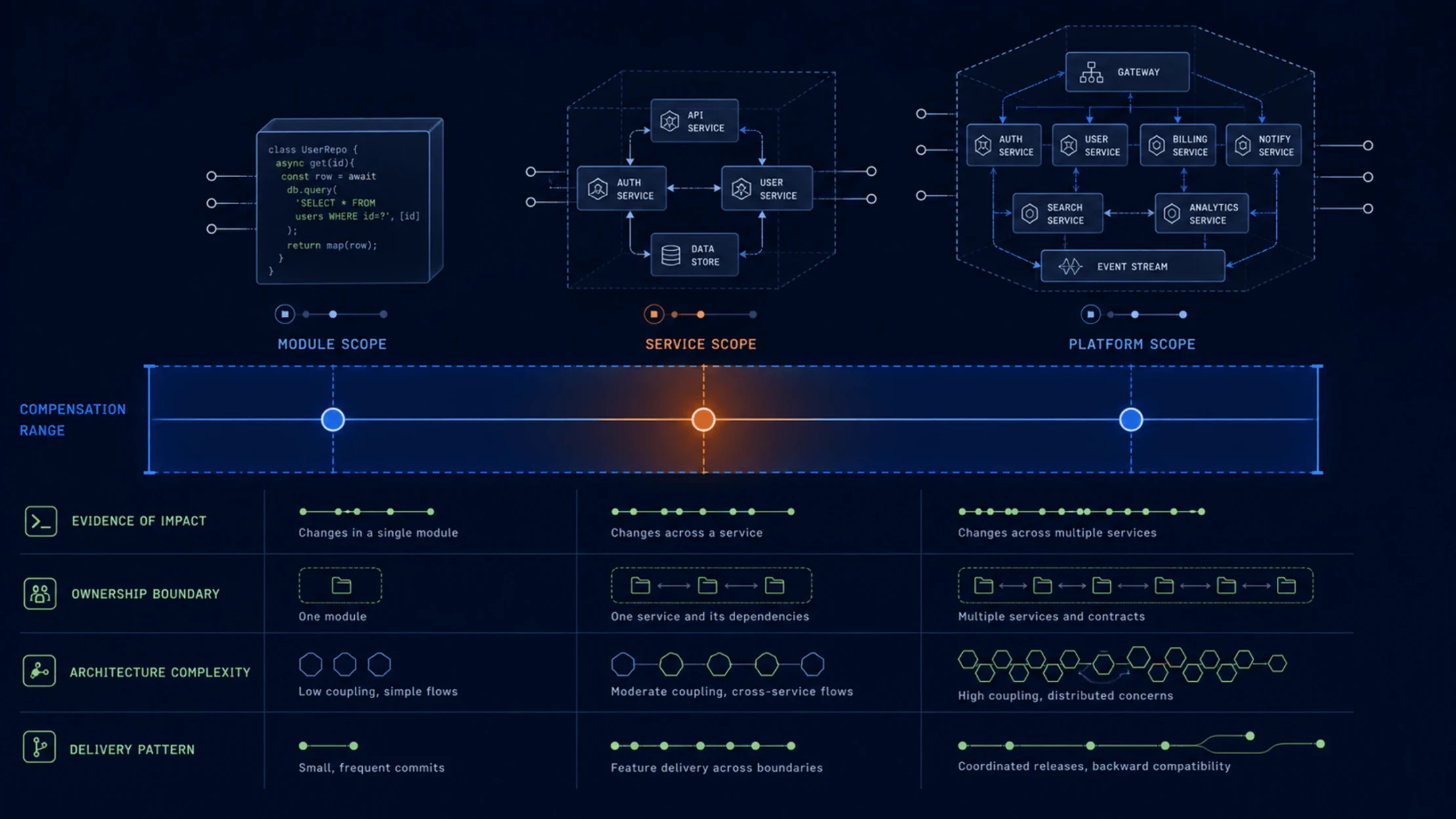
 Compensation grows with the scope and complexity of engineering responsibility
A developer sees a vacancy, likes the work, and still cannot answer the most basic question: can this company pay an amount I would accept? Publishing a salary range lets that decision happen before either side spends an hour on a call. It also forces the hiring team to agree on the level it can actually afford.
Two numbers alone are not enough. A range that has not been approved, covers several different jobs, or refers to a different contract type will create the same uncertainty later in the process. The public figure, interview criteria, and eventual offer need to tell the same story.
Define the role before pricing it
Compensation cannot repair an undefined job. Confirm the scope, level, decision authority, expected outcomes, location, employment form, and scarce capabilities before selecting a range. If stakeholders describe different roles, a single range will hide the disagreement until the final interview.
Use an internal level framework where one exists, but translate it into responsibilities a candidate can recognise. Titles vary sharply between companies. A senior engineer in one organisation may lead architecture across teams; in another, the same title means independent delivery within one product squad.
Record the evidence that separates the lower, middle, and upper parts of the range. This keeps interviewers from assigning level through intuition after meeting a candidate they like. It also gives recruiters a fair explanation of how the offer will be calibrated.
Build the range from comparable inputs
Use compensation data relevant to the role’s location, employment form, discipline, and level. Internal pay relationships matter alongside external data. A range that attracts candidates but creates unexplained differences with current employees transfers the problem into retention and trust.
Document the date and source of each input. Market data ages, and a number copied from an old vacancy can become detached from current approval. Avoid presenting a midpoint as a universal market truth; it is a company decision informed by available evidence.
For cross-border hiring, distinguish gross salary, net pay, employer cost, and contractor invoice value. Taxes, benefits, leave, social contributions, and currency risk differ. These figures should not be compared as if they represent the same arrangement. Qualified payroll and legal advice is necessary for the jurisdictions involved.
Choose a range that communicates a real decision
The lower bound should be an amount the company would genuinely offer to someone who meets the published requirements at the intended level. The upper bound should be reachable within the same role, not reserved for a different job that has not been advertised.
An excessively wide range creates nominal compliance but weak information. It pushes the real negotiation back into private conversation and may attract candidates whose expectations the company never intended to meet. A range that is too narrow can create false precision when the company is open to adjacent levels.
If more than one level is genuinely possible, state that clearly and explain how scope changes. Consider separate vacancies when the responsibilities, interview bar, or reporting relationship would be materially different. One page should not quietly contain three jobs.
State what the figures mean
Every published range needs context:
- currency and payment period;
- gross, net, or invoice basis;
- employment or contract form;
- whether location changes the range;
- fixed compensation versus variable pay;
- major benefits or equity described separately;
- review cadence, if the company has an established policy.
Do not combine the theoretical value of every benefit into one impressive total unless candidates can understand the assumptions. Equity requires its own explanation; a paper valuation is not cash salary. Bonuses should be described by target, conditions, and whether payment is guaranteed.
For remote roles, say whether the company uses one global range, regional bands, or a location adjustment. None of these policies is automatically fair in every setting, but an unexplained adjustment during the offer stage will feel arbitrary.
Connect the range to the vacancy
Place compensation near the working conditions, not in a footnote. The title, seniority, responsibilities, and requirements should support the advertised band. If the text asks for technical leadership, on-call ownership, mentoring, and deep domain expertise while the approved range was built for a narrower individual-contributor role, rewrite the job or revisit the budget.
The guide to writing a technical job posting provides a full structure. Compensation is one part of that agreement, alongside work format, employment type, interview stages, and the problems the person will own.
Keep structured fields and visible text in sync. A search filter may show salary before a candidate opens the page. If that field uses a different basis from the body, the first signal is already misleading.
Discuss compensation early and consistently
A public range does not eliminate the conversation. Confirm the candidate has seen it and explain how placement is decided. Ask about expectations without forcing disclosure of previous salary, which may be irrelevant or restricted in some jurisdictions.
Recruiters and interviewers should use the same explanation. Create a short internal note covering the range basis, level criteria, approved exceptions, and escalation owner. Do not allow each interviewer to improvise a different promise about bonuses, review timing, or remote-location policy.
If a candidate’s expectation is above the range, decide whether the role can change. Continuing through several interviews while hoping the issue disappears wastes both sides’ time. If the budget changes, update the public page promptly rather than leaving stale figures in search results.
Handle exceptions without undermining the policy
Exceptions may be justified by a different level, rare relevant experience, a competing offer, location, or a revised role. Record the reason and compare it with similar decisions. An exception that cannot be explained consistently is a warning that the framework needs work.
Do not stretch the public range after selecting a candidate merely to make the offer appear compliant. If the approved scope has changed, update the vacancy and consider whether other candidates were assessed against the wrong role.
Review the effect on internal equity. Transparency creates questions from current employees, and those questions may be legitimate. Prepare managers to discuss pay philosophy and correction processes instead of treating the vacancy range as information intended only for outsiders.
Measure whether transparency improves the process
Track outcomes that reveal clarity: candidate withdrawals related to compensation, recruiter screens ending on expectations, offer acceptance, exceptions, time spent negotiating, and questions repeated across interviews. Compare by role and employment model.
Do not interpret more applications as proof of success. A useful range may reduce volume while increasing the share of viable conversations. Candidate feedback can also reveal whether the range is understood and whether later discussions match the page.
Review live developer vacancies with salary filters to see how compensation interacts with role and work-format information. The employer’s responsibility is to keep those fields current for the life of the vacancy.
Keep the published range current
Assign ownership for range approval, publication, exceptions, and updates. Review the data when a role reopens, when responsibilities change, or when observed offers repeatedly cluster outside the band. Archive closed vacancies so outdated ranges do not continue to attract search traffic.
Requirements differ by jurisdiction and continue to change. This guide describes an operating approach, not legal advice. Employers should confirm applicable disclosure, equal-pay, recordkeeping, and candidate-data rules with qualified counsel.
A credible range lets a developer make an earlier decision and gives the company a defensible basis for the offer. It does not have to predict every negotiation. It does have to be a statement the hiring team is prepared to honour.
See the plans and one-off tools available for direct technical hiring.